Healthcare organizations are under pressure to improve patient access, protect sensitive data, and keep digital systems running without adding unnecessary cost. For many U.S. providers, payers, and healthtech companies, healthcare IT solutions are no longer limited to software, infrastructure, or internal help desks. They now include skilled support teams that can handle technical workflows, patient-facing issues, administrative coordination, and system-related service requests with speed and care.
This is where Colombia creates a strong nearshore advantage.
SuperStaff’s Colombia office gives U.S. healthcare organizations access to bilingual, culturally aligned support teams in a time zone that supports real-time collaboration. For SMEs and midmarket companies, this model helps close operational gaps without stretching internal teams too thin.
Why Healthcare IT Support Now Needs More Than Technology
Digital healthcare depends on people as much as platforms. A patient portal can only improve access if someone helps patients log in, reset passwords, understand next steps, and report issues clearly. An electronic health record system only supports better care when teams can route tickets, verify information, and coordinate with the right department.
Healthcare IT solutions must support the full experience around the technology.
For U.S. healthcare companies, that means building support capacity across several workflows, such as:
- Patient portal assistance
- Help desk support
- Appointment system support
- Claims platform coordination
- EHR and EMR ticket routing
- Basic troubleshooting
- Data entry and validation
- Back-office healthcare administration
These tasks may seem routine, but delays can affect patient satisfaction, provider productivity, and revenue cycle movement. When internal teams absorb every request, they lose time for higher-value clinical, operational, or technical work.
The Colombia Advantage for U.S. Healthcare Operations
Nearshore support from Colombia gives healthcare leaders a practical way to strengthen service coverage. The location matters because many U.S. healthcare workflows need fast responses during business hours. Teams must communicate clearly, escalate issues quickly, and work closely with internal staff.
Healthcare IT solutions supported by Colombia-based teams can help U.S. organizations avoid the friction that often comes with distant offshore models. Time zone alignment supports live coaching, faster huddles, easier quality reviews, and smoother collaboration between client teams and outsourced staff.
This is especially helpful for SMEs and midmarket healthcare companies that do not always have large internal IT or operations departments. They need support that feels integrated, not disconnected.
SuperStaff’s Colombia office can help build teams that support both English and Spanish-speaking patients, members, or users. That bilingual capability is valuable for healthcare organizations serving diverse U.S. communities.
Where Outsourced Healthcare IT Support Adds Value
Healthcare leaders often think about outsourcing after volume has already become a problem. Tickets pile up. Call wait times increase. Internal staff start handling repetitive issues instead of strategic work. Patient-facing teams feel pressure from both technical and service-related requests.
A better approach is to use healthcare IT solutions as part of workforce planning.
Outsourced support can help in areas where consistency, documentation, and responsiveness matter. Examples include helping patients navigate portals, supporting providers with system access issues, assisting members with digital account questions, and routing technical cases to the proper internal team.
This does not require outsourcing clinical judgment or sensitive decision-making. It requires building a structured support layer that protects internal bandwidth while improving service flow.
For healthcare organizations, the right partner should understand that support is not only about answering calls. It is about managing interactions carefully, following procedures, documenting accurately, and escalating issues when needed.
Support Roles That Help Healthcare Teams Scale
The strongest healthcare IT solutions combine process discipline with trained support talent. U.S. healthcare companies can use nearshore teams to manage repeatable work while keeping control over policies, tools, and decision-making.
SuperStaff can help organizations build teams for roles such as:
- Healthcare help desk representatives
- Patient support specialists
- Technical support agents
- Bilingual customer service representatives
- Back-office healthcare assistants
- Claims support coordinators
- Appointment support agents
- Data processing support staff
These roles can support hospitals, clinics, telehealth platforms, insurance organizations, healthcare SaaS providers, and medical service companies.
For example, a telehealth company may need help assisting patients who cannot access their accounts before a virtual visit. A medical billing platform may need agents who can help users understand system navigation and route unresolved issues. A clinic network may need support staff to help manage scheduling system questions and patient follow-ups.
These are practical business problems. They require reliable people, not just better tools.
Security and Process Discipline Must Come First
Healthcare outsourcing requires a careful approach. Organizations handle sensitive information, and support teams must understand the importance of privacy, access control, documentation, and escalation procedures.
Healthcare IT solutions should be built around secure workflows. That means clear role definitions, controlled system access, proper training, quality checks, and consistent reporting. It also means choosing a partner that understands healthcare support cannot be handled casually.
SuperStaff works with clients to align outsourced teams with their operating standards. The goal is to support productivity while respecting the compliance requirements that healthcare organizations must manage.
This is especially important for IT-related healthcare workflows. Support agents may not diagnose technical infrastructure issues at the engineering level, but they often serve as the first point of contact. They gather information, confirm user details, document concerns, and escalate cases properly.
That first layer can either reduce friction or create more work. Training and process design make the difference.
Why SMEs and Midmarket Healthcare Companies Need Flexible Capacity
Large healthcare organizations often have mature support departments. Smaller and midmarket companies usually face a different challenge. They need strong support coverage, but they may not have the budget or hiring capacity to build every function in-house.
Healthcare IT solutions supported through outsourcing give these companies a more flexible path.
Instead of hiring full internal teams for every support need, leaders can build targeted support pods. They can start with patient access support, technical help desk coverage, or back-office coordination, then expand based on demand.
This model works well for companies experiencing growth, seasonal volume changes, product launches, system migrations, or new patient service lines. It also helps organizations avoid overloading internal employees with work that can be structured and delegated.
The result is not only cost control. It is better focus.
Internal teams can spend more time improving systems, managing care operations, strengthening provider relationships, and addressing complex issues. Outsourced teams can manage the repeatable workflows that keep daily operations moving.
Building Better Patient and User Experiences
Healthcare service experiences often break down during small moments. A patient cannot log in. A member cannot find the right form. A provider needs help with a system request. A claim-related question waits too long for routing.
These moments affect trust.
Healthcare IT solutions should help organizations respond before frustration grows. When support agents are trained well, they can reduce confusion, guide users through next steps, and keep issues moving through the proper channels.
For U.S. healthcare companies, Colombia-based support can create a stronger service experience because teams can work during overlapping hours. Managers can provide faster feedback. Clients can join live calibrations. Support agents can stay closer to the daily rhythm of the business.
That matters when healthcare users expect both speed and accuracy.
What to Look for in a Healthcare Support Partner
Outsourcing healthcare IT support should not start with headcount alone. It should start with the workflow. Leaders need to define what support agents will handle, what must be escalated, what systems they will access, and how quality will be measured.
Healthcare IT solutions perform best when the partner can support recruitment, training, management, and reporting. A reliable provider should help clients build a team structure that fits the work, not force every account into the same model.
Before choosing a partner, healthcare leaders should ask:
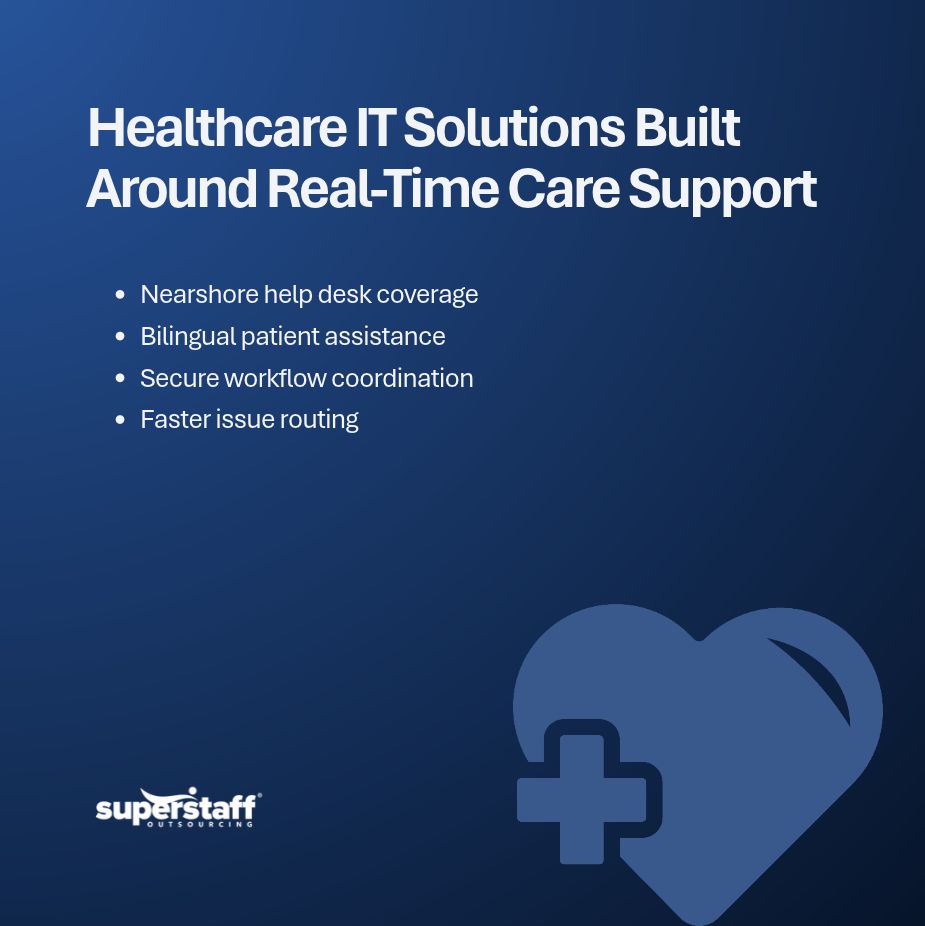
- Can the team support U.S. business hours?
- Can agents communicate clearly with patients, members, and internal teams?
- Can the partner support bilingual service needs?
- Can workflows be documented and monitored?
- Can quality standards be reviewed regularly?
- Can the team scale as volume changes?
SuperStaff’s Colombia office is designed for organizations that need this kind of practical, managed support. It gives U.S. healthcare businesses access to nearshore talent while keeping collaboration easier and more responsive.
SuperStaff Colombia Helps Healthcare Teams Work Smarter
Healthcare organizations cannot afford slow support, unmanaged tickets, or overloaded internal teams. Technology may power the system, but trained people keep the experience moving.
Healthcare IT solutions become more effective when they include a reliable support layer for patients, providers, members, and internal users. With SuperStaff’s Colombia office, U.S. healthcare companies can build nearshore teams that support communication, responsiveness, and operational focus.
For SMEs and midmarket organizations, this is a practical way to strengthen service delivery without building every function internally.
SuperStaff helps healthcare businesses create managed support teams that fit their workflows, protect internal bandwidth, and improve day-to-day execution.
Explore SuperStaff’s services today and see how our Colombia-based teams can support your healthcare operations with skilled, responsive, and business-aligned talent.