Many companies review their budgets at the beginning of the year to identify rising expenses, adjust resource allocation, and set spending limits. However, reducing costs while maintaining daily operations can be difficult. Staffing requirements, administrative backlogs, and changing workloads may increase expenses, especially when internal teams have limited capacity.
Outsourcing offers businesses another way to manage these demands. By assigning selected responsibilities to external personnel, companies can reduce certain hiring and operating expenses while maintaining the staff needed to complete essential work. The approach also gives businesses more flexibility when workloads change throughout the year.
However, cost reduction should not come at the expense of accuracy or service quality. Companies need to identify which tasks are suitable for outsourcing, calculate the total costs, and establish clear performance expectations. This guide explains how businesses can use outsourcing to manage early-year expenses without disrupting daily operations.
Why Companies Prioritize Cost Control Early in the Year
The beginning of the year often brings new financial targets and spending requirements. Management teams review previous expenses, approve department budgets, and determine where resources should go. These decisions affect hiring, technology investments, administrative support, and other operating activities.
One common challenge is maintaining enough staff without increasing fixed payroll expenses unnecessarily. Hiring additional full-time employees involves salaries, benefits, recruitment, onboarding, equipment, and training. These expenses can become difficult to manage when workloads are temporary or unpredictable.
Outsourcing gives companies another staffing option. Instead of expanding every department internally, businesses can assign selected functions to external personnel based on their requirements. This can help control recruitment and infrastructure expenses while maintaining the support needed for daily operations.
Companies reviewing their current expenses can also consider how outsourcing can help manage operational costs, particularly when administrative workloads and staffing requirements increase.
Cost-Control Practices Businesses Can Implement With Outsourced Support
Outsourcing can support several cost-management practices, particularly when companies focus on routine responsibilities that require consistent attention.
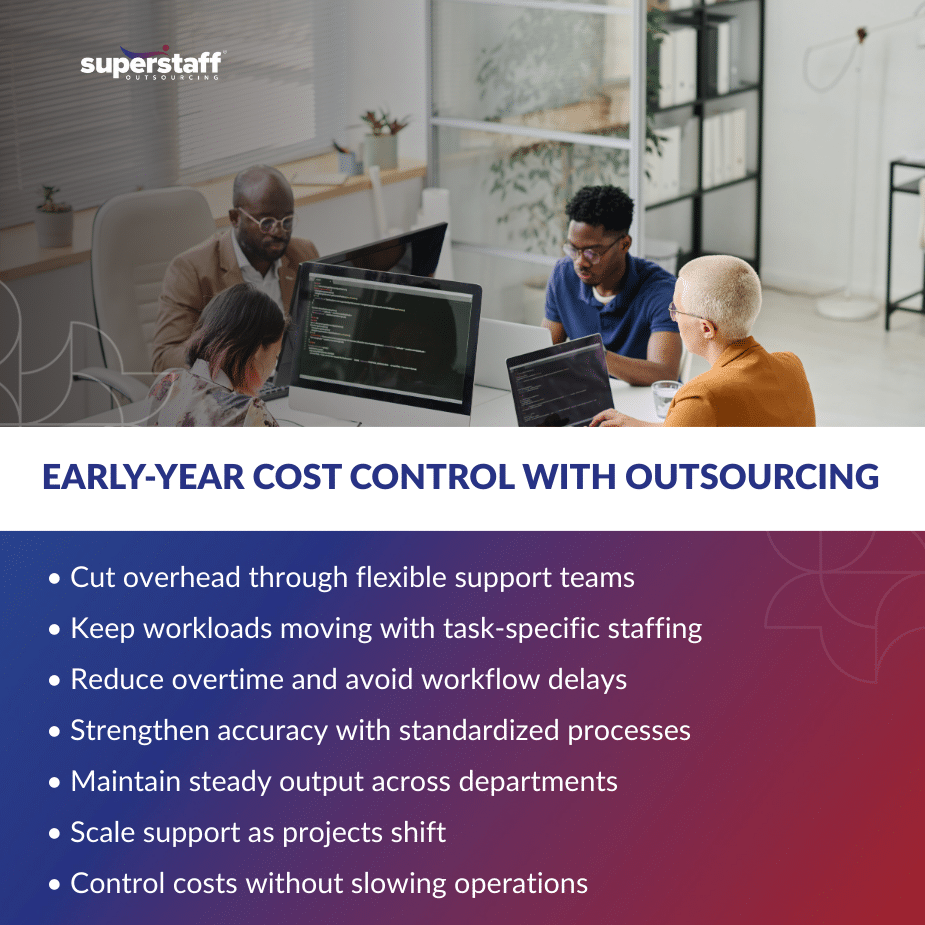
1. Adjusting staffing levels to match workloads
Some departments experience higher workloads during specific months, projects, or business cycles. Maintaining additional full-time employees during slower periods may increase payroll expenses without providing enough work to justify the cost.
Outsourced staffing allows businesses to adjust support based on operational requirements. Companies can add personnel when workloads increase and review staffing needs as demand changes.
2. Delegating repetitive administrative tasks
Data entry, document preparation, record maintenance, and routine reporting take time away from employees responsible for other business functions. Assigning these activities to outsourced personnel helps reduce administrative pressure and allows internal teams to focus on work that requires their expertise.
3. Reducing recruitment and onboarding expenses
Internal recruitment involves advertising vacancies, reviewing applications, conducting interviews, and preparing new employees for their roles. Outsourcing can reduce the amount of recruitment and onboarding work handled internally because the provider manages much of the staffing process.
However, businesses should still account for the time needed to explain their procedures and train assigned personnel.
4. Limiting overtime expenses
When internal employees handle excessive workloads, companies may need to approve additional working hours. Outsourced support can distribute selected responsibilities across a larger team, reducing the need for frequent overtime.
5. Standardizing procedures to reduce rework
Incorrect entries, incomplete documents, and inconsistent reporting can lead to additional labor costs. Clear instructions, approved templates, and routine quality checks help outsourced personnel complete assignments correctly and reduce repeated work.
6. Managing operating and infrastructure expenses
Additional in-house employees may require office space, computers, software access, and other resources. Depending on the outsourcing arrangement, some of these infrastructure responsibilities may be handled by the provider.
Businesses should compare these potential savings against service fees and any technology or transition costs they still need to cover.
Factors to Evaluate When Using Outsourcing for Cost Management
Reducing expenses requires more than comparing employee salaries with outsourcing rates. Companies should examine the full financial and operational impact before transferring responsibilities to an external provider.
Total cost of the arrangement
Calculate the expected service fees, transition expenses, training requirements, software costs, and management time. Compare these figures with the actual cost of performing the same tasks internally.
This is important because lower hourly rates do not always result in lower total operating costs. Businesses should also consider the key factors involved in an outsourcing decision, including hidden expenses, productivity, communication, and supplier management.
Communication and workflow systems
Both teams need clear communication channels and shared procedures. Businesses should identify how instructions will be assigned, how updates will be submitted, and who will handle urgent concerns.
Information security
Outsourced personnel may need access to financial records, customer information, and internal business documents. Companies should establish access restrictions, confidentiality requirements, and approved data-handling procedures.
Defined responsibilities
Every outsourced assignment should have a clear scope, expected output, and deadline. This prevents duplicated work and reduces the time spent correcting misunderstandings.
Performance measurements
Businesses should establish measurable indicators such as task completion rates, processing accuracy, turnaround times, and error frequency. These measurements help managers determine whether the arrangement delivers the expected value.
Onboarding and vendor support
Proper onboarding helps outsourced personnel understand company procedures and quality requirements. Businesses should also confirm that the provider can respond to technical issues, staffing concerns, and changes in workload.
How Outsourced Teams Help Maintain Operational Speed
Cost reduction should not create delays in customer service, financial processing, or administrative operations. Businesses still need enough personnel to complete recurring assignments and address daily requests.
Outsourced teams help maintain output by taking responsibility for selected tasks that might otherwise compete with internal priorities. For example, an outsourced employee can process records, prepare reports, and update spreadsheets while internal personnel handle approvals and business decisions.
This arrangement helps distribute workloads more evenly. It also allows companies to maintain coverage during periods when internal teams experience higher demand.
Staffing flexibility can also help businesses respond to changing labor expenses. Companies reviewing workforce costs can consider how flexible staffing helps businesses manage rising labor expenses while maintaining the personnel needed for essential functions.
Common Business Functions That Can Be Outsourced to Manage Costs
Not every business function needs to remain entirely within an internal department. Some recurring responsibilities can be assigned to external personnel without changing how the company manages its core operations.
Common examples include data entry and verification, invoice processing, payroll assistance, customer support, appointment scheduling, document management, vendor coordination, and administrative reporting.
These functions often involve repeatable procedures and defined outputs, making them suitable for structured outsourcing arrangements. Companies can also delegate backlog management when pending requests or incomplete records begin affecting regular operations.
The most suitable assignments depend on the company’s needs. Tasks involving sensitive approvals, confidential decisions, or specialized internal knowledge may require closer supervision or continued in-house management.
How Cost-Efficient Outsourcing Supports Internal Teams
Outsourcing can help internal employees manage their responsibilities without constantly taking on additional administrative work. When routine assignments are handled by external personnel, department managers can focus on planning, financial decisions, customer relationships, and other activities that require direct oversight.
It can also improve workload distribution. Employees are less likely to spend extended hours completing routine assignments when additional support is available. Organized documentation and consistent reporting further reduce the time spent searching for information or correcting incomplete work.
For companies with several departments, this arrangement can make resource allocation easier. Management can identify which activities require internal expertise and which can be handled through external support.
Choosing the Right Outsourcing Partner for Cost-Control Objectives
Selecting a provider requires careful evaluation of both service quality and pricing. Businesses should look beyond the initial quotation and determine whether the proposed arrangement can meet their operational requirements.
Important considerations include experience with similar workloads, transparent pricing, recruitment standards, employee training, information security, reporting procedures, and staffing flexibility.
Companies should also review the provider’s approach to quality monitoring and issue resolution. A low-cost arrangement may create additional expenses if work frequently requires corrections or if service interruptions affect business operations.
A clear service agreement should define responsibilities, expected performance, payment terms, confidentiality requirements, and procedures for handling changes. These details help both parties understand their obligations and keep the arrangement manageable.
SuperStaff Outsourcing Support for Cost-Conscious Workflows
SuperStaff provides trained professionals who support businesses with administrative and operational responsibilities. Depending on the company’s requirements, assigned personnel can assist with data entry, document management, accounting support, reporting, customer service, and other recurring tasks.
Through its administrative and back-office support services, SuperStaff helps companies manage administrative workloads through dedicated personnel and structured processes. This allows businesses to assign selected responsibilities externally while maintaining oversight of their internal operations.
Companies can also establish specific reporting requirements, quality standards, and staffing arrangements based on their needs. These measures help maintain consistency while giving management better visibility into assigned work.
Cost-Efficient Outsourcing for Early-Year Stability
Managing early-year expenses requires businesses to review how their resources are being used. Cutting necessary personnel or reducing support for essential functions can create delays and additional costs later. A better approach is to identify tasks that can be handled more efficiently through alternative staffing arrangements.
Outsourcing allows companies to manage selected workloads, reduce certain overhead expenses, and maintain operational support without expanding every internal department. The results depend on proper cost calculations, clear responsibilities, and regular performance reviews.
Businesses planning to adjust their staffing arrangements can discuss their staffing and operational requirements with SuperStaff to identify suitable outsourcing support for the year ahead.