Many companies still rely on systems built years ago. These workflows were designed for stability, not speed.
As business demands evolve, leaders are reassessing how work moves across teams. AI for business process automation is now influencing how organizations operate, how decisions are made, and how services are delivered.
The shift is steady and often unnoticed, yet its impact is reshaping operations, cost structures, and customer expectations.
Legacy Workflows Are Slowing Down Business Execution
Legacy workflows follow fixed steps. They depend on manual inputs and multiple layers of approval. Over time, these systems create delays that affect productivity and service delivery.
Processes that once worked efficiently begin to slow down as volume increases. Teams spend time managing repetitive tasks instead of focusing on higher-value work. Errors become more frequent due to manual handling, which leads to rework and inefficiencies.
As organizations scale, these limitations become more visible. Leaders begin to see that traditional workflows are no longer aligned with the pace of modern business.
AI Introduces Flexibility Into Rigid Processes
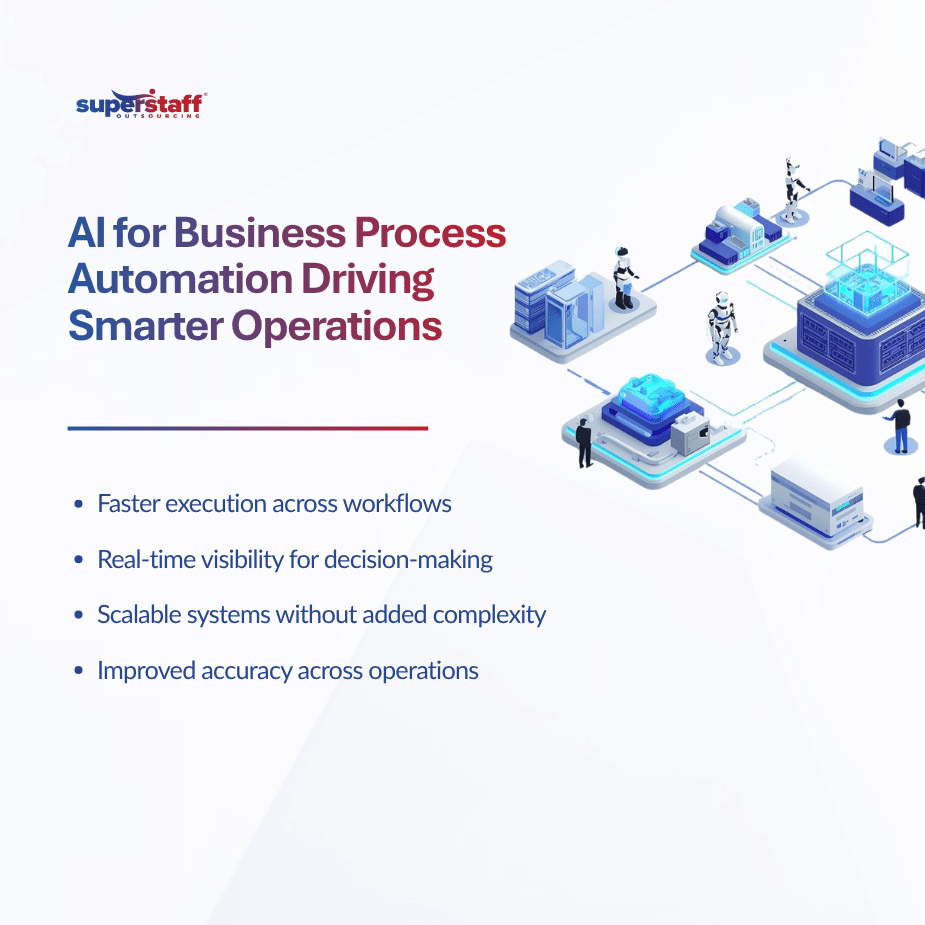
AI changes how workflows function by allowing systems to respond based on data rather than fixed rules. Tasks no longer need to follow a strict sequence when conditions change.
AI for business process automation enables workflows to adapt in real time. Customer inquiries can be categorized instantly and routed to the right team. Financial transactions can be validated without multiple manual checks.
This flexibility reduces bottlenecks and allows processes to move faster. Teams gain more control over operations while reducing the burden of routine tasks.
Operational Speed Becomes a Competitive Factor
Speed is now a key driver of business performance. Customers expect fast responses and consistent service across channels.
Companies that rely on manual workflows often struggle to meet these expectations. Delays in processing requests can affect customer satisfaction and business outcomes.
AI for business process automation improves turnaround time across departments. Customer support teams can respond faster, back-office processes move more efficiently, and data is processed without delay.
Faster execution allows businesses to stay responsive and competitive in changing markets.
Decision-Making Is Moving Closer to Real Time
Traditional decision-making relies on reports that summarize past performance. This approach limits the ability to respond quickly to current conditions.
AI enables continuous data analysis. Information is processed as it moves through workflows, allowing leaders to make decisions based on current insights.
AI for business process automation supports this shift by providing timely visibility into operations. Managers can adjust resources based on demand. Customer issues can be identified and addressed before they escalate.
This improves both accuracy and responsiveness across the organization.
Cost Structures Are Becoming More Predictable
Manual processes often introduce hidden costs. Errors, delays, and inefficiencies increase operational expenses over time.
Automation reduces these risks by standardizing workflows and minimizing unnecessary manual intervention.
AI for business process automation helps organizations manage costs more effectively. Resources can be allocated to tasks that require human expertise, while routine activities are handled by automated systems.
This leads to better cost control and improved financial visibility.
Workforce Roles Are Evolving Toward Higher Value Work
Automation does not eliminate the need for people. Instead, it changes how work is distributed across teams.
Routine tasks are handled by systems, allowing employees to focus on responsibilities that require judgment, communication, and problem-solving.
AI for business process automation supports this transition by reducing repetitive workloads. Teams become more productive because they spend more time on strategic activities.
This shift also contributes to better employee engagement and long-term retention.
Integration Challenges Require Structured Support
Adopting new systems can be complex, especially for organizations with established workflows. Integration requires careful planning and execution.
Many companies face challenges when implementing automation internally. Limited expertise and competing priorities can slow down adoption.
AI for business process automation becomes easier to implement when supported by experienced teams. Outsourcing partners provide the technical knowledge and operational support needed to integrate new systems without disrupting daily operations.
This approach allows businesses to move forward with confidence.
Customer Experience Improves With Consistent Processes
Customer expectations continue to rise. Consistency and accuracy are essential in every interaction.
Manual workflows often lead to delays and inconsistent responses. These issues affect customer trust and satisfaction.
AI for business process automation ensures that processes are standardized and efficient. Requests are handled quickly, information is processed accurately, and communication remains consistent.
This leads to better customer experiences and stronger relationships.
Scalability Becomes More Manageable
Growth introduces new challenges. Manual workflows require additional staff to handle increased volume, which can lead to higher costs and complexity.
Automation changes this dynamic by allowing systems to handle larger workloads without proportional increases in headcount.
AI for business process automation supports scalable operations by maintaining consistency across processes. Teams can focus on strategic priorities while systems manage routine tasks.
This enables businesses to grow without compromising efficiency.
Data Accuracy Strengthens Business Outcomes
Accurate data is essential for effective decision-making. Manual processes increase the risk of errors, which can affect outcomes across the organization.
AI-driven systems process and validate data with greater consistency.
AI for business process automation improves data accuracy across workflows. Reliable information allows leaders to make informed decisions and respond to changes with confidence.
This strengthens overall business performance.
The Shift Is Accelerating Across Industries
Organizations across industries are adopting automation to improve operations. Healthcare providers streamline patient coordination. Retail businesses enhance customer support. Financial institutions improve transaction processing.
AI for business process automation is becoming a standard approach for managing complex workflows. Companies that delay adoption risk falling behind in efficiency and service delivery.
The shift is not driven by trends but by practical business needs. Leaders are recognizing the value of systems that can adapt, scale, and deliver consistent results.
Building Smarter Operations With the Right Support
The move away from legacy workflows is reshaping how businesses operate. AI for business process automation is helping organizations improve speed, accuracy, and scalability. These changes allow companies to respond more effectively to market demands and customer expectations.
Successful adoption requires a balance between technology and human expertise. Systems can handle routine tasks, but people remain essential for decision-making and customer engagement.
SuperStaff supports this balance by integrating AI into workflows while maintaining strong human oversight. This approach ensures that automation enhances operations without compromising quality or service.
If your organization is ready to improve efficiency and modernize workflows, now is the time to take action. Connect with SuperStaff to explore how outsourced teams can help you implement AI-driven processes and scale with confidence.