
Ecommerce growth depends on visibility, trust, and conversion. That is why a strong content strategy for ecommerce has become a boardroom discussion, not just a marketing task. Leaders are no longer asking whether content matters. They are asking how to scale it without stretching internal teams too thin.
This guide breaks down what a modern approach looks like and how outsourcing helps ecommerce brands build consistent, high-performing content engines. Dive in to find out how to create a content strategy for ecommerce that works.
Why Ecommerce Content Strategy Is a Growth Lever
Content shapes every stage of the buying journey. From discovery to retention, it influences how customers evaluate products and brands.
Strong execution delivers three advantages:
- Higher organic traffic through search visibility
- Better conversion through education and clarity
- Stronger retention through post-purchase engagement
A thoughtful content strategy for ecommerce aligns messaging across channels so customers experience one cohesive brand voice. That alignment reduces friction and shortens decision cycles.
Start With Business Objectives, Not Content Types
Many ecommerce brands jump straight into blogs or videos. Strategic teams start with outcomes first.
Clarify goals such as:
- Increasing category-level traffic
- Improving product page conversion
- Supporting new product launches
- Reducing customer support load
Once objectives are clear, content decisions become easier. A well-built content strategy for ecommerce maps each asset to a measurable business result. That mindset keeps content tied to revenue, not vanity metrics.
Understand Your Buyers and Their Intent
Customer intent drives content relevance. Ecommerce buyers behave differently depending on where they are in the funnel.
Consider three core stages when crafting your ecommerce content marketing strategy:
- Discovery where users compare options
- Consideration where users evaluate features
- Post-purchase where users seek guidance
A structured content strategy for ecommerce ensures each stage has tailored assets. That includes comparison guides, FAQs, tutorials, and onboarding content. The goal is clarity, not volume.
Build a Search-Led Content Foundation
Search remains a primary acquisition channel for ecommerce brands. Buyers often begin with problem-based queries, not brand names.
Focus areas include:
- Category-level educational content
- Long-tail product guides
- Buyer comparison articles
- FAQ clusters that mirror customer questions
An effective content strategy for ecommerce uses search intent as a planning framework. Instead of chasing trends, teams build evergreen assets that compound traffic over time.
Optimize Product Pages as Content Hubs
Product pages are often underutilized content assets. Many brands treat them as static catalogs rather than conversion tools.
Enhancements that drive performance include:
- Structured benefit explanations
- Clear use-case scenarios
- Embedded FAQs based on real support questions
- Short-form educational content near purchase triggers
A mature content strategy for ecommerce treats product pages as dynamic content hubs. When done right, they reduce bounce rates and improve average order value.
Use Content to Reduce Support Costs
Customer experience teams often feel the impact of poor content. When product clarity is low, support tickets rise.
Strategic content reduces friction through:
- Help center articles that address common objections
- Post-purchase onboarding emails
- Troubleshooting guides
- How-to video libraries
A practical content strategy for ecommerce works closely with CX teams. Support insights become content inputs, creating a loop that improves both marketing and operations.
Maintain Consistency Across Channels
Fragmented messaging weakens trust. Ecommerce brands often publish across multiple platforms without unified guidelines.
Consistency requires:
- Shared tone and voice documentation
- Clear messaging pillars
- Cross-channel content calendars
- Alignment between marketing and customer support
A scalable content strategy for ecommerce ensures that blog posts, product descriptions, social media, and email flows reinforce the same value narrative. That consistency strengthens brand credibility.
Build a Repeatable Content Production System
Many ecommerce teams struggle with consistency because production relies on ad hoc workflows. Scaling requires structure.
Key operational elements include:
- Standardized briefs and templates
- Editorial calendars tied to campaigns
- Clear review and approval workflows
- Performance tracking loops
A structured content strategy for ecommerce behaves like an operating system. It enables predictable output without overwhelming internal teams.
Where Outsourcing Fits Into the Equation
Execution gaps often emerge once strategy is clear. Internal teams understand what to do but lack bandwidth to deliver consistently.
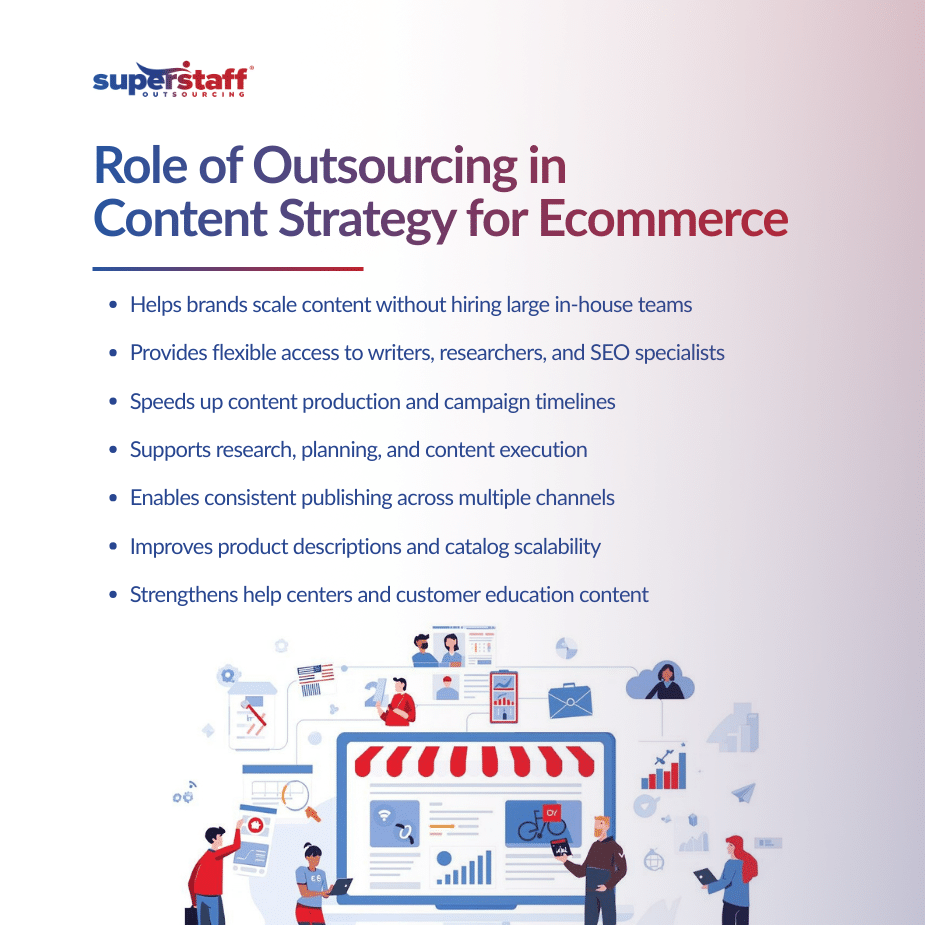
Outsourcing helps in areas such as:
- Content research and planning support
- SEO-driven writing and optimization
- Product description scaling
- Help center and knowledge base creation
- Content repurposing across channels
An outsourced model allows ecommerce brands to maintain velocity. Instead of hiring multiple specialists internally, leaders gain flexible access to trained teams.
Why the Philippines Is a Strategic Content Hub
Location matters when outsourcing content. To create the ideal content strategy for online stores, brands benefit from partners that combine cultural alignment and operational maturity.
The Philippines offers several advantages:
- Strong English fluency aligned with U.S. audiences
- Familiarity with Western ecommerce trends
- Established BPO infrastructure
- Cost efficiency without quality compromise
A well-managed content strategy for ecommerce becomes easier to sustain when execution teams operate in time zones that support overnight production cycles. That continuity accelerates campaign timelines.
What to Look for in an Outsourcing Partner
Not all providers understand ecommerce nuances. Decision-makers should evaluate partners through a strategic lens.
Important considerations include:
- Experience supporting ecommerce brands
- Ability to align with brand voice
- Integrated CX and content capabilities
- Transparent workflows and communication
The right partner strengthens your content strategy for ecommerce without creating complexity. Alignment matters more than scale alone.
From Strategy to Scalable Execution
Content maturity happens in phases. Early-stage brands focus on traffic acquisition. Growth-stage companies prioritize conversion and retention. Mature brands build integrated content ecosystems.
Outsourcing supports every phase by:
- Accelerating execution speed
- Providing specialized expertise
- Freeing internal teams for higher-value work
- Enabling predictable output
A long-term content strategy for ecommerce depends on sustainability. Consistency drives compounding results, and sustainable execution requires the right operational model.
Elevate Your Content Strategy for Ecommerce With the Right Outsourcing Partner
A well-executed content strategy for ecommerce connects visibility, conversion, and customer experience into one cohesive engine. Leaders who treat content as a strategic function gain measurable advantages in acquisition, retention, and operational efficiency.
Execution is where many brands struggle. That is where SuperStaff comes in. Our Philippines-based teams help ecommerce companies scale content production, optimize customer-facing assets, and align messaging across channels without overloading internal resources.
If you are ready to build a scalable content engine that supports growth and customer experience, explore how SuperStaff can support your ecommerce strategy today.