Patient support is one of the most important parts of healthcare operations. A caller may be trying to schedule an appointment, confirm instructions, ask about billing, or follow up on a referral. The quality of that interaction affects how patients experience the organization. Healthcare call center best practices help providers create support systems that are clear, secure, responsive, and patient-centered.
For U.S. healthcare organizations, Colombia-based nearshore teams can support these best practices by providing bilingual communication, U.S. time zone alignment, and scalable staffing. This allows providers to improve patient access without overwhelming internal teams.
The goal is not simply to answer calls faster. The goal is to support patients with accuracy, professionalism, and care.
Start with clear patient communication
One of the most important healthcare call center best practices is using simple and clear communication. Patients may be confused, anxious, or unfamiliar with healthcare processes. Agents should avoid unnecessary jargon and confirm that the patient understands the next step.
This matters for appointment preparation, referral coordination, insurance updates, and patient portal support. A small misunderstanding can lead to missed appointments, incomplete forms, or unnecessary callbacks.
Colombia-based bilingual agents can help support English-speaking and Spanish-speaking patients with clearer communication. For healthcare organizations serving diverse communities, this improves accessibility and reduces friction.
Build strong documentation habits
Documentation is another essential part of healthcare call center best practices. Agents must record patient interactions accurately so internal teams can act on the information.
Strong documentation includes:
- Correct patient details
- Clear reason for the call
- Appointment status
- Follow-up requirements
- Escalation notes
- Missing information
- Insurance updates
- Referral-related details
Accurate notes help providers, schedulers, billing teams, and care coordinators work from the same information.
Nearshore teams in Colombia can support these workflows during U.S. business hours, making it easier to coordinate updates in real time.
Define escalation rules
Not every patient concern can be resolved by a call center agent. Some issues require a nurse, provider, billing specialist, or internal administrator.
Healthcare call center best practices require clear escalation rules. Agents should know which situations need urgent routing, which can be handled through standard follow-up, and which must be documented for review.
This protects patients and helps the organization manage risk.
Escalation rules should include:
- Medical concern routing
- Billing dispute routing
- Urgent appointment issues
- Prescription-related inquiries
- Referral complications
- Patient complaints
- System access problems
- Sensitive information updates
A trained nearshore team should follow approved workflows and avoid making clinical judgments.
Prioritize bilingual access
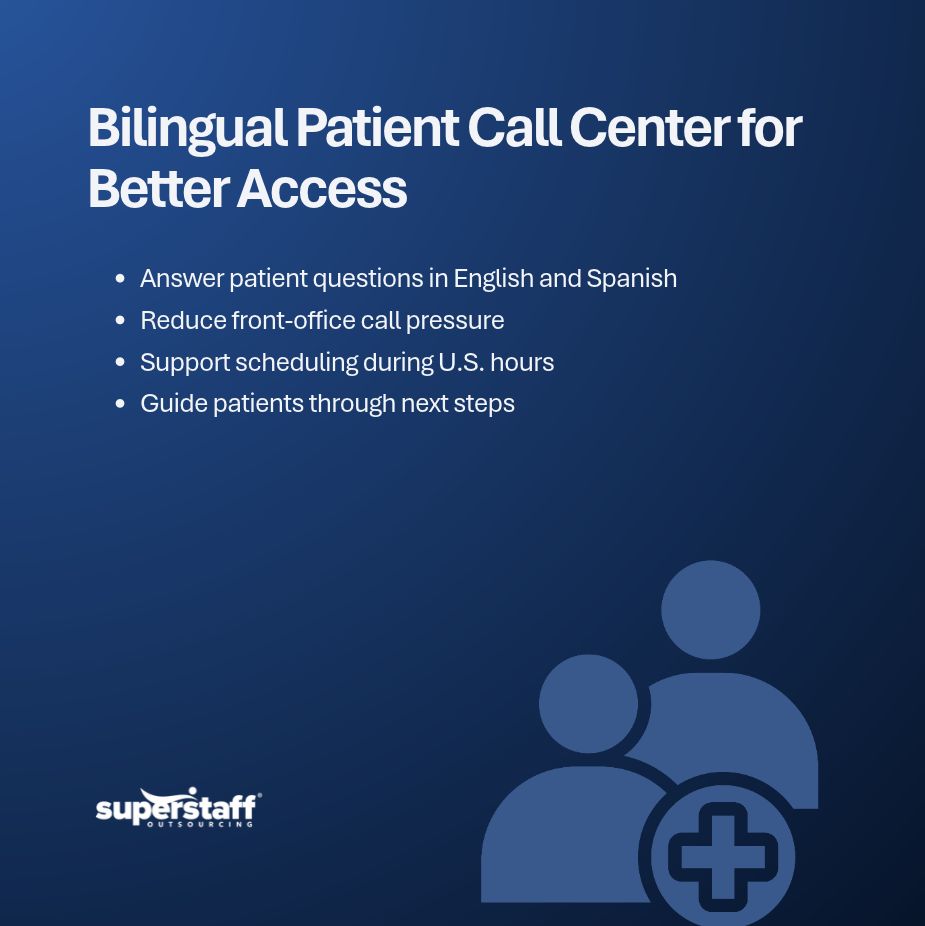
For many U.S. healthcare organizations, bilingual support is no longer optional. Spanish-speaking patients may need help scheduling visits, understanding instructions, or updating information.
One of the most valuable healthcare call center best practices is offering language support that makes patients feel understood. A Colombia-based team can provide English and Spanish communication while working in schedules aligned with U.S. operations.
This improves patient access and reduces the burden on bilingual staff inside the clinic or provider office.
Protect patient information
Healthcare support must be handled with confidentiality and care. Patient information should only be accessed, discussed, and documented according to approved policies and applicable privacy requirements.
A strong healthcare call center partner should provide secure workflows, agent training, quality monitoring, and clear access controls.
Healthcare call center best practices should always include:
- Identity verification
- Secure documentation
- Limited system access
- Privacy training
- Approved scripts
- Escalation protocols
- Quality audits
- Supervisor review
Trust depends on how carefully patient information is handled.
Measure performance beyond speed
Call speed matters, but it should not be the only measure of success. A call center that rushes patients can create more confusion and repeat calls.
Healthcare call center best practices should track quality, accuracy, resolution, patient satisfaction, documentation completeness, and escalation compliance.
Leaders should review questions such as:
- Are patients receiving clear next steps?
- Are appointments scheduled correctly?
- Are calls documented properly?
- Are urgent concerns routed quickly?
- Are Spanish-speaking patients supported well?
- Are repeat calls decreasing?
These insights can help healthcare organizations improve both support operations and the patient journey.
How SuperStaff helps
SuperStaff helps U.S. healthcare organizations build Colombia-based nearshore call center and back-office support teams. These teams can support scheduling, patient communication, bilingual service, documentation, and administrative workflows.
Healthcare call center best practices work best when the right people, process, and management structure are in place. SuperStaff helps providers create nearshore support teams that improve patient access while keeping operations aligned with U.S. business hours. Explore SuperStaff’s Colombia healthcare outsourcing services to build better patient support.