Launching a new product takes time, money, and the right people. However, many companies struggle to train models quickly because the process requires skilled teams, large datasets, and constant testing. As a result, product launches often slow down before the project even reaches the market.
That is why many businesses now outsource AI model training to trusted outsourcing providers. This setup helps companies complete projects faster while keeping internal teams focused on product strategy, customer experience, and business growth. At the same time, outsourcing gives businesses access to trained specialists who can manage large-scale training projects efficiently.
Whether a company is building chat support tools, recommendation systems, automation platforms, or analytics software, the right outsourcing partner can help speed up development timelines. Moreover, businesses can reduce hiring delays and improve project flexibility without increasing operational pressure.
Why Companies Outsource Model Training Projects
Building and training models requires technical knowledge, organized workflows, and reliable support teams. Because of this, companies often look outside their organization for help.
1. Faster Access to Skilled Teams
Hiring internal specialists can take months. Meanwhile, outsourcing providers already have experienced teams ready to work on training projects.
When companies outsource AI model training, they avoid long recruitment cycles. In addition, they gain access to professionals who can support data preparation, annotation, validation, and other training-related tasks. Businesses can also explore AI outsourcing services when they need scalable human support for AI workflows.
2. Lower Operational Costs
Building an in-house training team requires salaries, software, equipment, and management support. For many companies, these expenses grow quickly.
Outsourcing helps businesses control costs while still maintaining quality. Furthermore, companies can scale projects based on current needs instead of committing to large permanent teams.
3. Better Project Flexibility
Product requirements often change during development. Therefore, businesses need flexible support that can adapt quickly.
Outsourcing partners can adjust team size, workloads, and schedules depending on project demands. As a result, companies can respond faster to development updates and changing data requirements.
4. Faster Product Launch Timelines
Speed matters during product development. Delays can affect customer acquisition, revenue opportunities, and competitive positioning.
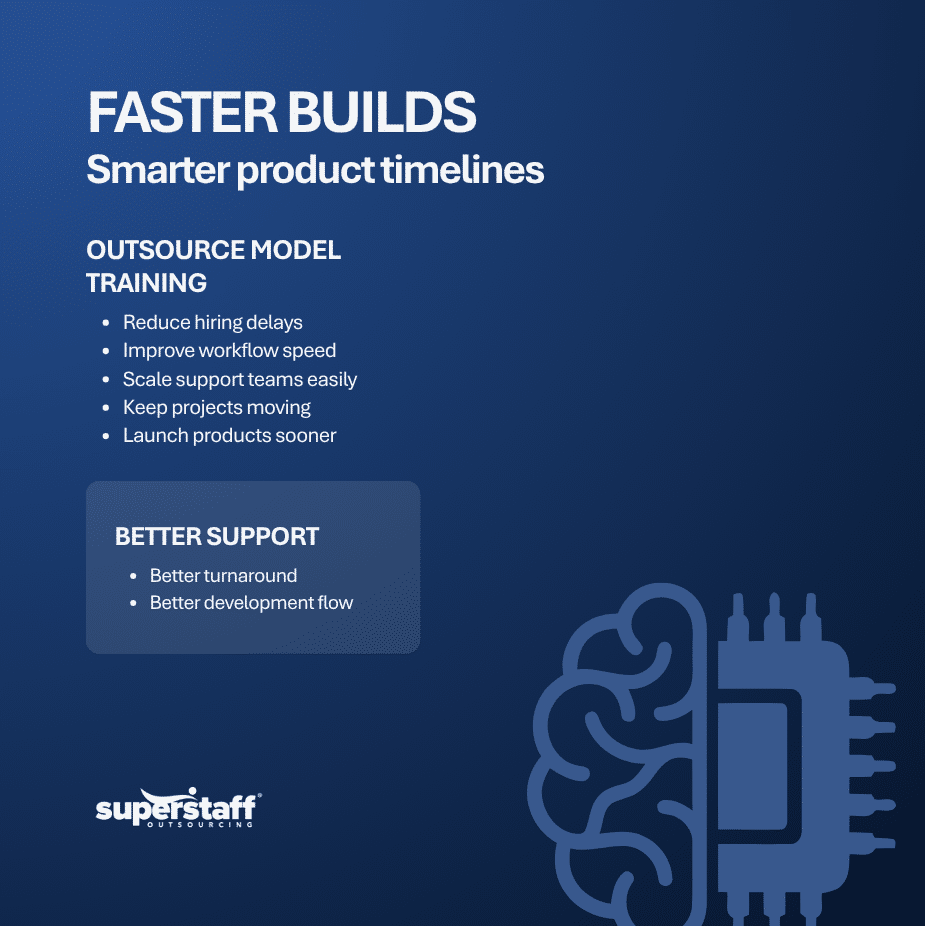
Companies that outsource AI model training can move time-consuming data and review tasks to dedicated external teams. Meanwhile, internal employees can continue handling product design, engineering, operations, and customer needs.
5. Reduced Management Pressure
Managing large internal teams requires constant oversight. However, experienced outsourcing providers can supply project management, quality control processes, and structured workflows.
This setup allows businesses to reduce administrative work while keeping training operations organized. Leadership and technical teams can then spend more time on product strategy and development priorities.
Key Areas Outsourcing Teams Can Support
Training projects involve several moving parts. Therefore, outsourcing providers can support multiple stages of the AI development process.
1. Data Collection and Preparation
Models need accurate and organized data to perform as intended. Because of this, outsourcing teams can help gather, clean, categorize, and structure datasets before training begins.
These teams may also identify duplicate information, correct formatting issues, and organize data based on project guidelines. Well-managed datasets give technical teams a stronger foundation for model development.
2. Data Annotation Services
Many AI products rely on labeled datasets for training purposes. For example, image recognition systems, chat platforms, and recommendation tools may require properly classified data.
Outsourcing teams can handle:
- Text labeling
- Image annotation
- Audio transcription
- Video tagging
- Sentiment classification
Companies handling large labeling workloads can use AI data annotation outsourcing to add trained human reviewers without building a large annotation team internally.
3. Model Testing and Validation
Testing helps teams identify problems before deployment. Outsourcing teams can support evaluation and validation processes based on guidelines established by the company’s AI and engineering teams.
Independent guidance can also support stronger AI practices. The NIST AI Risk Management Framework provides a voluntary framework for managing AI risks throughout the design, development, use, and evaluation of AI systems.
4. Workflow Management
Training projects involve deadlines, milestones, and coordination between different teams. Without proper management, bottlenecks can delay development.
Outsourcing providers can assign dedicated project managers to oversee defined operational tasks, track progress, and coordinate with internal stakeholders. Consequently, communication becomes more organized and project teams gain clearer visibility into ongoing work.
5. Ongoing Training Support
AI products may require new datasets, updated labels, output reviews, and other forms of ongoing human support after launch. Therefore, companies should consider long-term operational needs when planning outsourcing projects.
When businesses outsource AI model training support, they can adjust external resources as datasets and product requirements change.
How Outsourcing Speeds Up Product Development
Product development depends heavily on efficient execution. Therefore, companies need organized workflows and enough resources to keep projects moving.
1. Shorter Hiring Timelines
Recruiting technical and operational professionals takes time. Additionally, onboarding new employees can delay project progress even further.
Outsourcing gives businesses another way to add trained resources without relying entirely on permanent internal hiring. As a result, teams can begin defined project tasks sooner.
2. Around-the-Clock Operations
Some outsourcing providers operate across multiple time zones. Because of this, certain data preparation, annotation, validation, and support tasks can continue outside the internal team’s regular working hours.
Companies should still establish clear handoff procedures and quality controls to keep work consistent across different schedules.
3. Faster Testing Cycles
Testing and human review can create bottlenecks when internal teams have limited capacity. Dedicated external teams can support repetitive evaluation and validation tasks throughout the project.
Consequently, engineering teams can receive feedback and reviewed data sooner, allowing them to make adjustments during development.
4. Easier Scalability
Project demands can increase unexpectedly. Therefore, businesses need support systems that can grow with larger datasets and tighter deadlines.
Companies can use broader outsourcing solutions to add operational capacity based on project size and workload. This flexibility reduces the need to build permanent teams for temporary increases in demand.
5. Improved Internal Focus
Internal employees already manage product development, technical decisions, and daily business responsibilities. Adding large volumes of repetitive training support tasks can reduce the time available for these priorities.
When companies outsource AI model training, internal teams can focus on model architecture, product strategy, customer needs, and other work that requires their direct expertise.
What To Look for in an Outsourcing Partner
Choosing the right provider affects project quality, security, and workflow efficiency. Therefore, businesses should evaluate outsourcing partners carefully before making a decision.
1. Industry Experience
Experienced providers understand common project challenges and workflow requirements. Look for companies with relevant experience supporting AI, technology, software, healthcare, finance, e-commerce, or other areas related to your use case.
Companies should also ask about the specific AI support roles a provider can supply rather than assuming every outsourcing team has the same technical capabilities.
2. Strong Data Security Practices
Training projects can involve proprietary or sensitive information. Therefore, businesses should choose providers with clear security procedures and confidentiality policies.
Ask potential partners about data access controls, employee training, handling procedures, security standards, and compliance requirements before sharing project data.
3. Scalable Workforce Support
Business needs change over time. Because of this, outsourcing partners should offer flexible staffing options that match different stages of development.
A scalable provider should be able to support smaller pilot workloads as well as larger annotation, validation, or operational projects.
4. Clear Communication Processes
Strong communication reduces delays and misunderstandings. Therefore, companies should choose providers with organized reporting systems, defined points of contact, and clear escalation procedures.
Regular updates also give internal teams better visibility into progress, quality concerns, and changing workload requirements.
5. Quality Assurance Systems
Reliable outsourcing providers should follow structured quality checks throughout the project. Businesses should ask how work is reviewed, how errors are tracked, and how feedback is incorporated into future tasks.
Clear quality standards improve consistency and make it easier for internal AI teams to use outsourced outputs in their development workflows.
Build Faster With The Right Outsourcing Team
Companies need efficient development cycles to respond to changing customer needs and product requirements. However, building large internal teams for data preparation, annotation, validation, and other support tasks can take time and increase costs. That is why businesses may outsource AI model training support to add the resources needed for demanding development projects.
SuperStaff provides AI support teams for data annotation, validation, documentation, and related operational workflows. Businesses can add trained human support while keeping core technical decisions and product development within their internal teams.
Ready to discuss your AI project? Contact SuperStaff to share your requirements and learn how outsourced AI support can fit your product development needs.