For U.S. companies that outsource to the Philippines, culture does not stop at the home office. It extends to every customer support agent, back-office specialist, team lead, and offshore employee representing the brand. That is why understanding the right ways to improve culture at work matters when building a high-performing outsourced team.
Many SMEs and midmarket companies start outsourcing to solve capacity issues. They need more support coverage. They need faster response times. They need reliable talent without the cost and complexity of expanding locally.
But after the first hires are made, another question appears. How do you build a team that feels connected, accountable, and aligned with your standards?
The answer starts with treating culture as an operating system, not an HR slogan.
Ways to Improve Culture at Work Start With Clear Expectations
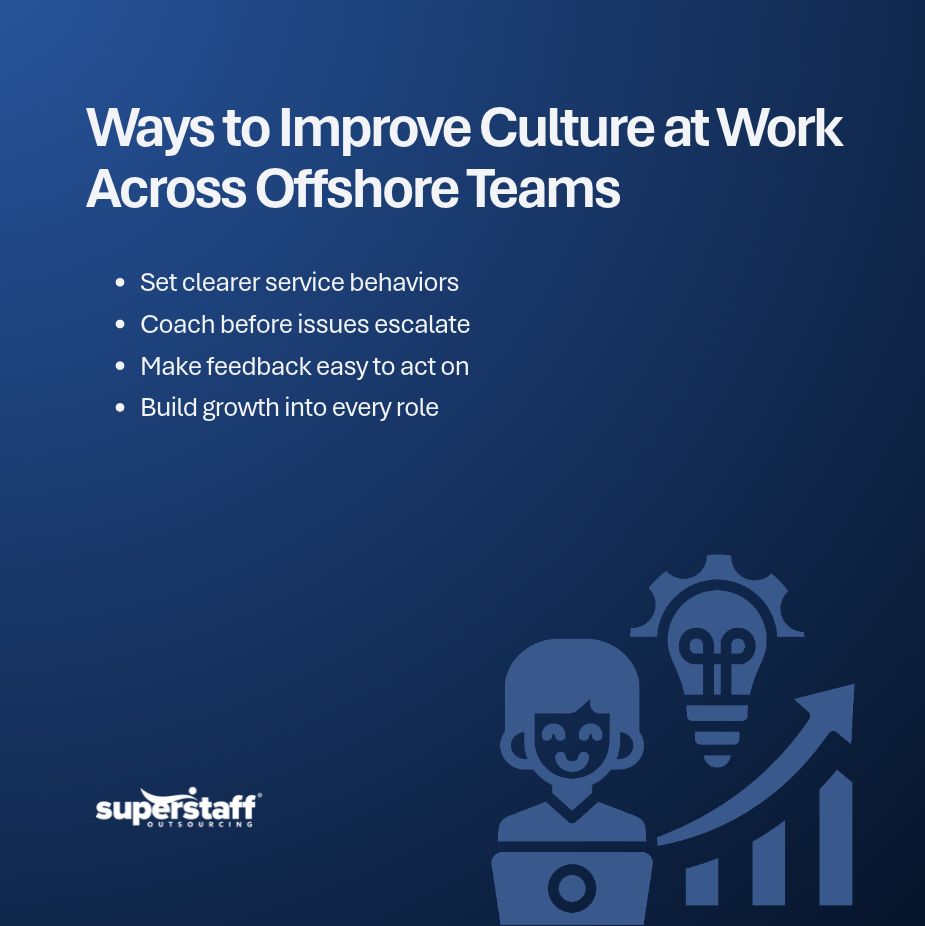
One of the most practical ways to improve culture at work is to define what good performance looks like before the team starts.
Offshore employees need more than a job description. They need clarity on workflows, escalation rules, communication style, customer tone, quality standards, and decision-making boundaries.
This is especially important for call center and customer service operations. Agents handle live concerns. They represent the client’s brand in real time. If expectations are vague, performance becomes inconsistent.
A strong culture gives employees a clear answer to these questions:
- What does success look like in this role?
- How should we communicate with customers?
- When should an issue be escalated?
- What behaviors are expected across the team?
- How do we measure quality fairly?
When these standards are documented and reinforced, employees feel more secure. Managers also gain a stronger basis for coaching and accountability.
Make Communication Practical and Consistent
Communication is one of the most overlooked ways to improve culture at work, especially across time zones.
A U.S. company working with an offshore team in the Philippines needs a communication rhythm that supports speed without creating confusion. Daily updates, weekly huddles, performance check-ins, and clear reporting channels help teams stay aligned.
The goal is not to add more meetings. The goal is to make communication useful.
For example, a customer support team may need a short start-of-shift briefing to review customer issues, system updates, and priorities. A back-office team may need an end-of-day summary that tracks completed tasks, pending items, and blockers.
These habits reduce guesswork. They also help offshore employees feel connected to the business instead of isolated from it.
When leaders look for ways to improve culture at work, they should ask whether employees receive the right information at the right time. Silence creates uncertainty. Consistency builds trust.
Build Culture Into Onboarding
Onboarding is one of the earliest ways to improve culture at work because it shapes how employees understand the company from day one.
A rushed onboarding process may fill the seat quickly, but it can weaken performance later. Employees need time to understand the client’s brand, tools, policies, service standards, and internal communication style.
For outsourced teams, onboarding should cover both technical readiness and cultural alignment. Employees should know how to handle customer concerns, how to ask for help, and how their work contributes to the client’s goals.
A structured onboarding program may include:
- Role-specific training
- Account orientation
- Tool and system walkthroughs
- Quality guidelines
- Sample customer scenarios
- Coaching expectations
- Workplace conduct standards
This gives offshore employees a stronger start. It also helps U.S. clients see the outsourced team as a real extension of their operations.
Train Managers to Lead Across Locations
Leadership behavior has a direct impact on culture. One of the most effective ways to improve culture at work is to equip managers with the skills to lead distributed teams.
Managing an offshore team requires clarity, patience, and consistency. Leaders must know how to coach performance, give feedback, handle concerns, and keep teams engaged even when they are not in the same office.
This matters for SMEs and midmarket companies because many are still new to offshore workforce management. They may have strong internal teams in the U.S., but offshore operations need a slightly different management approach.
Managers should avoid assumptions. They should explain context, confirm understanding, and create space for questions.
At the same time, they should hold the team to clear standards. A healthy culture is not overly casual. It is respectful, organized, and performance-focused.
Recognize Good Work in Specific Terms
Recognition is one of the simplest ways to improve culture at work, but it works best when it is specific.
Generic praise can feel nice for a moment. Specific recognition helps employees understand what behavior should continue.
Instead of saying, “Great job,” a manager can say, “You handled that difficult customer calmly, followed the escalation process, and documented the issue clearly.”
That kind of feedback reinforces standards. It also helps employees connect their actions to business outcomes.
For offshore teams, recognition is especially important because distance can make good work less visible. A customer service agent may resolve dozens of concerns in a shift. A logistics support specialist may prevent a delay through careful follow-up. A data entry associate may protect accuracy through detailed review.
When leaders notice these contributions, employees feel valued and more connected to the client’s mission.
Create Fair Paths for Growth
Career growth is one of the strongest ways to improve culture at work because it gives employees a reason to stay and improve.
Offshore teams should not feel like temporary support layers. They should have visible opportunities to grow into quality assurance, training, team lead, workforce, reporting, or specialized account roles.
This is important for retention. Employees are more likely to commit when they see a future.
For U.S. companies, career development also protects business continuity. Promoting from within creates team members who already understand the account, customer expectations, systems, and workflows.
Growth does not always require a promotion right away. It can start with cross-training, mentorship, stretch tasks, coaching sessions, or skill-building programs.
When companies explore ways to improve culture at work, they should look at whether employees can picture their next step.
Connect Employee Experience to Customer Experience
Customer experience depends heavily on employee experience. This is one of the most strategic ways to improve culture at work for outsourced call center operations.
Agents who feel unsupported may struggle to stay patient with customers. Employees who lack tools or guidance may take longer to resolve issues. Teams that receive inconsistent feedback may deliver inconsistent service.
A better culture helps stabilize the customer experience.
For example, if an e-commerce company outsources customer service, agents need clear refund rules, updated product information, and quick access to supervisors. If a healthcare support team handles appointment scheduling, employees need accurate workflows, privacy reminders, and calm escalation support.
Culture shows up in these details. It is reflected in how employees are trained, supported, coached, and trusted to do the work well.
Use Outsourcing Partners That Understand People Operations
Choosing the right outsourcing partner is one of the most important ways to improve culture at work when expanding into the Philippines.
A good partner should do more than recruit agents. It should help manage the employee experience, support operations, reinforce policies, and maintain professional standards.
For U.S. companies, this is where SuperStaff’s value becomes practical. SuperStaff helps clients build offshore teams with recruitment, onboarding, HR support, operations management, and workplace structure already in place.
This matters because culture requires daily execution. It depends on how people are hired, trained, scheduled, coached, and supported.
When a partner understands both service delivery and employee care, offshore teams become easier to manage and more likely to perform consistently.
Measure Culture Through Daily Signals
Leaders often look for large initiatives when they discuss ways to improve culture at work. But culture is usually visible in daily signals.
Do employees ask questions when something is unclear? Do managers give timely feedback? Do teams follow processes without constant reminders? Do people raise concerns before problems grow? Do employees understand how their work affects customers?
These signals reveal whether the culture is working.
For outsourced teams, leaders should review both performance data and employee feedback. Quality scores, attendance, attrition trends, coaching notes, and client feedback can help identify where culture needs attention.
The goal is not to monitor employees in a harsh way. The goal is to remove friction and strengthen the systems that help people perform.
Build a Workplace Culture That Scales With the Business
The best ways to improve culture at work are practical, consistent, and tied to business outcomes. Clear expectations, strong onboarding, better communication, fair growth paths, and people-centered management all help offshore teams succeed.
For U.S. SMEs and midmarket companies, culture should be part of the outsourcing strategy from the beginning. A team may be offshore, but the customer experience remains part of the brand.
SuperStaff helps companies build Philippine-based teams that are trained, supported, and aligned with client goals. If your business is ready to improve service capacity while building a stronger workplace culture, explore SuperStaff’s outsourcing services today and see how the right offshore team can help you grow with confidence.